

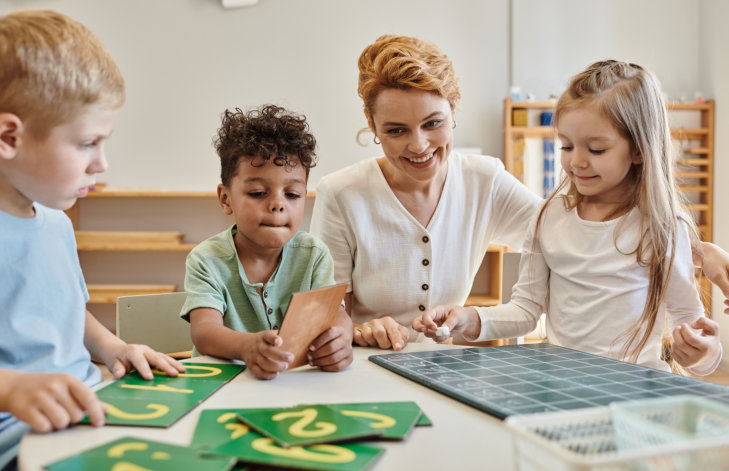
Early math skills begin long before children sit at a desk to solve problems. Young children learn about numbers through play, conversation, movement, and simple routines. Counting five blocks, noticing that one plate has more crackers, or spotting the number 3 on a sign can help children connect numbers with real experiences. At Haymarket Children’s Academy, we know that teaching numbers to young children can be a positive experience when activities align with their age, interests, and developing abilities. Simple experiences can help children build familiarity with numbers.
- Why Early Math Skills Matter
Early math skills give children a foundation for later learning. Counting, recognizing numbers, sorting, comparing, and noticing patterns help children understand quantity and order. These skills support problem-solving, memory, attention, and logical thinking. Children do not need lengthy lessons to begin learning. Short, playful experiences can give them repeated chances to practice.
Parents and caregivers can introduce math through ordinary moments. Asking a child to count apples at the grocery store, find two socks, or tell you how many cups are on the table turns a familiar activity into a learning opportunity. The goal is to help children see numbers as part of everyday life rather than worksheets. - Count Objects Children Know
Counting familiar objects is one of the easiest math activities for preschoolers and kids. Children can count toy cars, stuffed animals, blocks, crayons, or pieces of fruit. Start with small groups and let children touch each object as they say each number. This can help them connect a number word with an object.
Counting can become part of routines, too. Count steps as you walk, count toys as you put them away, or count spoonfuls during a cooking activity. These moments give children repeated practice without feeling like a formal lesson. As children become comfortable, ask them to count larger groups or tell you how many objects they counted. - Help Children Recognize Numbers
Number recognition for children grows through frequent, relaxed exposure. Point out numbers on calendars, books, clocks, or household items. Ask children to find a specific number, match a number card to a group of objects, or trace a large number with their finger.
Songs and movement can make number learning easier to enjoy. Sing counting songs, clap five times, jump three times, or march and count. - Sort, Match, and Create Patterns
Sorting gives children early practice with grouping and comparing. Offer buttons, blocks, toy animals, or other safe objects and ask children to group them by color, size, or shape. After sorting, ask questions such as, “Which group has more?” or “Which group has fewer?” This helps children begin comparing quantities in a natural way.
Patterns can be introduced with simple materials. Make a pattern with a red block and a blue block, then ask the child what should come next. Try patterns with movements, such as clap, tap, clap, tap. These activities support early math skills by helping children notice order and predict what comes next. - Explore Shapes and Simple Math
Numbers are one part of early math in early childhood education. Basic shapes give children another way to describe and understand objects around them. Invite children to find circles, squares, triangles, and rectangles in books, toys, rooms, or outdoor spaces. Talk about how shapes look and how they are alike or different.
Simple addition and subtraction ideas can be introduced through everyday objects. If a child has three crackers and receives one more, ask how many they have now. If five blocks are on the floor and one is put away, ask how many remain. Keep the questions short and let children use objects to work out the answer. - Make Number Games Part of Play
Games can give children a fun reason to count, match, and compare. Try a counting scavenger hunt by asking children to find three leaves, four blocks, or five toy animals. Roll a large, easy-to-read die and have the child count out that many objects. Play a matching game with number cards and groups of objects.
Parents can create math activities at home using materials they have on hand. Paper plates can become number targets, cups can be used for counting games, and household objects can be sorted into groups. These preschool learning activities can be adjusted to fit a child’s current abilities. A child learning to count to five may need smaller groups than one who can count to twenty. - Keep Learning Positive and Age-Appropriate
Children learn at different rates, so learning numbers through play and early number activities should allow room for practice without pressure. Praise effort, ask open questions, and give children time to think. If a child makes an error, gently count the objects together and try again. A calm approach can help children build confidence with numbers before kindergarten and support kindergarten readiness skills.
We create learning experiences that give young children opportunities to explore early math through play, routines, movement, and age-appropriate activities. Our approach supports children as they build foundational skills in a setting that encourages curiosity and participation. Families can contact Haymarket Children’s Academy to learn more about our early childhood programs and how we support children’s early learning needs.

Leave a Reply